|


In the Bible
Israel's official religion contrasts sharply with contemporary polytheisms in
the role assigned to demons, which in the bible is practically nil. Magic was
prohibited among the Israelites from very early times, for already the oldest
collection of laws, the Book of the Covenant, contains the command, "You
shall not tolerate a sorceress."[1]
Since much of pagan magic was protective – intended to keep demons away
or to expel them – obviously Israel's religion aimed at a very radical
extirpation of traffic with demons. Calamities and illnesses were not from demons
but from the Lord.[2]
The Israelite
conception of demons, as it existed in the popular mind or the literary imagination,
resembled in some ways that held elsewhere. Demons live in deserts or ruins.[3]
They inflict sickness on men[4].
They trouble men's minds.[5]
and deceive them[6]
– but nevertheless these evil spirits are sent by the Lord.
Specific
demons:
 Foreign
gods are called shedim a word related to the Akkadian word sedu (demon,
good or evil).[7] Foreign
gods are called shedim a word related to the Akkadian word sedu (demon,
good or evil).[7]
se'irim — hairy demons, satyrs is also
applied contemptuously to foreign deities.[8]
Lilith — associated with the child-stealing
demon, she made her way into folklore.[9]
Mavet — related to Canaanite underworld god
(Mot).[10]
Resheph — another major god of the Canaanite
religion who becomes a demonic figure in biblical literature, particularly as
the god of plague.[11]
Dever — pestilence, demonic herald who matches
with YHWH to battle.[12]
Azazel — demon though to live in the wilderness.[13]
In
the Talmud
 References
are made to a belief in demonology during the tannaitic period. The mazzikim
("harmful spirits") are said to have been created on the eve of the
Sabbath of creation, but this late reference is the only one made to demons
in the entire Mishnah. Among the accomplishments of both Hillel and his disciple
R. Johanan b. Zakkai was their knowledge of "the speech of the shedim."[14]
Although these and other statements refer to the Land of Israel, the Jerusalem
Talmud is markedly free from demonology. A passage in the Babylonian Talmud
specifically states that various beliefs connected with demons which were current
in Babylon were isnored in Erez Yisrael. That the Babylonian Talmud is replete
with demonology is clearly the influence of the belief in demons which was widespread
in Babylon. References
are made to a belief in demonology during the tannaitic period. The mazzikim
("harmful spirits") are said to have been created on the eve of the
Sabbath of creation, but this late reference is the only one made to demons
in the entire Mishnah. Among the accomplishments of both Hillel and his disciple
R. Johanan b. Zakkai was their knowledge of "the speech of the shedim."[14]
Although these and other statements refer to the Land of Israel, the Jerusalem
Talmud is markedly free from demonology. A passage in the Babylonian Talmud
specifically states that various beliefs connected with demons which were current
in Babylon were isnored in Erez Yisrael. That the Babylonian Talmud is replete
with demonology is clearly the influence of the belief in demons which was widespread
in Babylon.
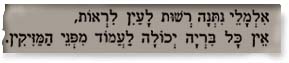
The Babylonian
Jews lived in a world which was filled with demons and spirits, malevolent and
sometimes benevolent, who inhabited the air, the trees, water, roofs of houses,
and privies. They are invisible: "If the eye could see them, no one could
endure them. They surround one on all sides. They are more numerous than humans,
each person has a thousand on his left and then thousand on his right"
and they are responsible for various inconveniences. Yet by taking certain steps,
in the morning one can see their footprints in the shape of those of a cock.[15]
Whereas in
the Kabbalah there is an attempt to systematize demonology (see below) there
is no sign in the talmudic literature. The material is vast and inchoate, scatted
in profusion and without system throughout the whole Talmud and in the midrashim.
In
the Kabbalah
 The
kabbalists made use of all the motifs current in the Talmud and Midrash with
regard to demons. New elements were developed or added, mainly in two directions:
1. The kabbalists attempted to systematize demonology so that it would fit into
their understanding of the world;
2. New and varied elements were added from external sources, mainly from medieval
Arabic demonology, from Christian demonology, and from the popular beliefs of
the Germans and Slavs. At times these elements were linked, more or less logically,
to Jewish demonology, and were thus "Judaized" to some extent. However,
frequently the link was only external; material was incorporated into Jewish
demonology with almost no explicit Jewish adaptation.
The works of
the kabbalists contain contradictory conceptions of the demons and the power
of imagination. Traditions of the past as well as the cultural environment and
the intellectual outlook of each individual kabbalist contributed toward the
diversification of the beliefs. In Nahmanides' [16]
opinion, the demons (shedim) are to be found in waste (shedudim),
ruined and cold places such as in the North. They were not created out of the
four elements (as many believed), but only out of fire and air. They have subtle
bodies, imperceptible by the human senses, and these subtle bodies allow them
to fly through fire and air. Because they are composed of different elements,
they come under the laws of creation and decay, and they die like human beings.
While the 13th-century Castilian kabbalists (Isaac b. Jacob ha-Kohen, Moses
of Burgos, and Moses de Leon) linked the hosts of demons to the subhuman world
on earth, the Zohar,[17]
following a talmudic legend, stressed the origin of the demons in sexual intercourse
between humans and demonic powers.
The terms shedim
and mazzikim were often used as synonyms, but in some sources there is
a certain differentiation. In the Zohar it is thought that the spirits
of evil men become mazzikim after their death. However, there are also good-natured
devils who are prepared to help and do favors to men. This is supposed to be
particularly true of those demons who are ruled by Ashmedai (Asmodeus) who accept
the Torah and are considered "Jewish demons." Their existence is mentioned
by the German Hasidim (Hasidei Ashkenaz) in the 12th and 13th centuries[18]
as well as in the Zohar.

According to
the Zohar, the demons sometimes poke fun at men. They tell them lies
about the future and mingle truth and lies in dream. The feet of the demons
are crooked ( Zohar 3:229b). In numerous sources four mothers of demons
are mentioned: Lilith, Naaman, Agrah and Mahalath (who is sometimes replaced
by Rahab). The demons under their rule go out in their hosts at appointed times
and constitute a danger to the world; male and female witches gather at specific
places, and learn the art of witchcraft from the arch-devils, recalling the
witches in Christian demonology.
There are other
systems of demonology in Jewish literature, not necessarily connected with kabbalistic
ideas and some obviously preceded them. A complete system of kabbalistic demonology
was presented after the period of the Zohar, in Sibbat Ma'aseh ha-Egel
ve'Inyan ha-Shedim, which develops internal Jewish motifs. A combination
of the Zohar and Arab sources characterizes the book Zefunei Ziyyoni
by Menahem Zion of Cologne (late 14th cent.), which enumerates a long list of
important demons and their functions while preserving their Arabic names. This
book was one of the channels through which Arab elements reached the practical
kabbalists among the Jews of Germany and Poland, and they recur often, albeit
with errors, in collections of demonology in Hebrew and Yiddish.
"The
rabbis taught: Six things have been said about demons..."
Curious?
Among North
African and Near Eastern Jews, elements of kabbalistic and Arabic demonology
(including collections of remedies and amulets) were combined even without literary
intermediaries. In Jewish Ashkenazi demonology of the late Middle Ages, elements
from Christian magic and demonology were introduced as well.
|
[1]
Ex. 22:17 [back]
[2] Amos 3:6; I Samuel 16:14 [back]
[3] Lev. 16:10; Isa. 13:21; 34:14 [back]
[4] Psalms 91:5-6 [back]
[5] Saul, I Sam. 16:15, 23 [back]
[6] I Kings 22:22-23 [back]
[7] Deut. 32:17, Psalms 106:37 [back]
[8] Lev. 17:7. II Chronicles 11:15 [back]
[9] Isa. 13:21; 34:14 [back]
[10] Isaiah 28:15, 18; Jer. 9:20, Hos 13:14, Job 18:13
[back]
[11] Deut. 33:29; Psalms 78:48; Psalms 76:4 [back]
[12] Hab. 3:5; Psalms 91:5-6 [back]
[13] Lev. 16:8, 10, 26 [back]
[14] Sof. 16:9; Sukkot 28a [back]
[15] Berakhot 6a [back]
[16] Moses Nahmanides (1194-1270), biblical exegete,
kabbalist, halakhist, poet and physician, leading intellectual and communal
leader of the Jewish community in Catalonia during a crucial period of
change. [back]
[17] Zohar, recognized by kabbalists since the
14th century as the important work of mystical teaching. The largest section,
the Zohar proper, consists of a mystical commentary on parts of
the Bible, delivered in the form of discussions by a group of 2nd-century
rabbis and scholars in Palestine, led by Shimon bar Yohai. [back]
[18] The Pious Ones, a term that refers to the various
circles of Jewish mystics and pietists in Ashkenaz (that is, Germany (mainly
the Rhineland) and northern France - in the second half of the twelfth
and thirteenth centuries. The term refers to several schools, most of
them independent of each other, which developed different theologies and
world views; many of their ideas and symbols were later absorbed by the
Kabbalah. [back] |
|
From
the article on Demonology, Encyclopedia Judaica, Vol 5. Keter Publishing
House, Jerusalem, 1972.
|
|