|
In
the seventeenth and eighteenth centuries there flourished a school
of Jewish painting which centered largely in southeastern Poland.
The artists painted the walls and ceilings of the wooden synagogues
with a colorful tapestry of motifs; all of these synagogues were
burned down in World War II. The ceiling of the Hodorov synagogue
(reconstructed and on view at Beth Hatefutsoth, the Museum of
the Jewish Diaspora in Tel Aviv) was decorated with rich motifs
from the world of flora and fauna, with border designs incorporating
written verses, and with all sorts of fantastic creatures. We
focus here on the latter.
|
The background
of the entire ceiling is decorated with a rich interplay of plants
and pairs of animals: a lioness sitting and chewing a flower;
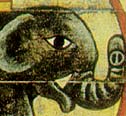
an elephant carrying a tower on its back, flanked by trees on
and beside which are perched storks holding snake-like reptiles
in their mouths; a hind grazing peacefully; an eagle gripping
a hare in its beak and claws. On either side of the eagle are
trees on which bears are climbing, and on the crest of one of
the trees is a pot of honey. Large conches fan out downwards to
span the angles between the four corners of the ceiling and the
walls of the hall.
This painted
ceiling is like a song of praise to the Creator, sung by his creations.
The abundance of divine creation is presented in sharp lines and
strong colors. The composition is a harmonious whole in which
the colorful portrayal of the universe represents the perfection
of Creation.
The period
when this ceiling was painted coincides with the rise of mysticism
and messianic movements throughout Poland. Kabbalistic symbolism
and imagery were common among the Jews of the region, and their
tidings of redemption are manifest in the paintings on the ceiling.
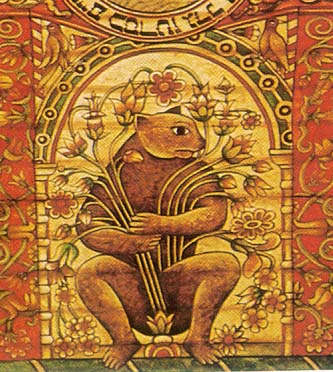
The bear, for example, known in folklore as a restless animal,
here sits peacefully in one of the arches resembling gates, the
Tree of Life rising out of its lap.
Blossoming
branches, which stem from a single source at the bear's feet,
split in two on either side of the seated animals and reunite
in a single flower over his head. The bear, encircled with flowers,
evokes associations of the prophecy of the End of Days. The Tree
of Life which splits in two and then comes together again perhaps
symbolizes the mystical Kabbalistic dualism according to which
the Tree of Life and the Tree of Knowledge express different forces
acting in the universe. The unification of the two symbolizes
the messianic era.
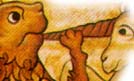
The lion and
the unicorn, painted opposite the bear and framed in a similar
way, represent forces of great strength which reach a certain
balance, thus making it possible for the forces of life and redemption
to grow in them. These forces are symbolized by the Tree of Life.
It is hard to tell whether the two animals, which possess supernatural
strength, are embracing one another or wrestling.
The large,
strong horn appears stuck in the lion's mouth, an image which
calls to mind the blowing of the ram's horn. The blast of the
horn is suggestive of victory, kingship and the coming of the
Messiah.
Elsewhere
on the ceiling is a painting of a lioness chewing a flower, a
clear allusion to the End of Days. The hind, which in the Zohar
is a symbol of the Divine Presence, can be seen here grazing peacefully.
The elephant carrying a tower is a symbol of might which has known
submission and forbearance. The eagle is generally symbolic of
the divine powers of deliverance and watchful protection.
The eagle,
which for centuries has been associated with the heights, the
heavens and fire, is here surrounded by the signs of the zodiac,
forming a symbolic representation of both the celestial realm
and the Jewish people (twelve zodiac signs standing for the twelve
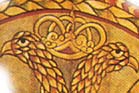
tribes). The eagle has two heads and a crown, a common portrayal
in European art and heraldry due to Byzantine and oriental influences.
In
many civilizations, the dualism represented by the eagle's
two-headedness stood for the spiritual ambivalence which
strikes a balance between good and evil. In the Christian
kingdoms it alluded to the duality of the throne: both
royalty and divinity. In Jewish culture, the dual shape
of the eagle was influenced by the idea of the dualism
in Divine Providence, manifested by God's grace and judgment.
|
Living
Symbols: Symbols in Jewish Art and Tradition, by Ida
Huberman (Modan Publishers, 1996) |