|
When
Louis Ginzberg died in 1953, he was recognized as the world's
upstanding scholar in the field of Talmudic learning. His studies
were carried on at the universities of Berlin, Strassburg and
Heidelberg, and from 1902 at the Jewish Theological Seminary in
New York, where he served with distinction as Professor of Talmud
for more than half a century. The following brief selection opened
his lecture, "The Significance of the Halachah for Jewish
History," delivered at the Hebrew University in Jerusalem
during the academic year 1929-1930, which was later published
as part of a collection of essays.
|
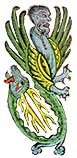 With
your permission I shall commence my lecture by recounting an incident
that happened to me. It is memory from boyhood, which means the time
when I had already been liberated from the hard discipline of the master
of the heder and, though yet a child of nine, had begun to study, in
the traditional phrase, "by myself." I was then studying the
tractate Baba Batra. When I reached the tales of Rabbah bar bar Hannah,
doubts began to disturb my mind; my peace was particularly troubled
by those geese who were so fat that they had streams of oil flowing
from them and by the bird that was so big that the waters of the sea
reached only to its ankles and its head split the heavens.
With
your permission I shall commence my lecture by recounting an incident
that happened to me. It is memory from boyhood, which means the time
when I had already been liberated from the hard discipline of the master
of the heder and, though yet a child of nine, had begun to study, in
the traditional phrase, "by myself." I was then studying the
tractate Baba Batra. When I reached the tales of Rabbah bar bar Hannah,
doubts began to disturb my mind; my peace was particularly troubled
by those geese who were so fat that they had streams of oil flowing
from them and by the bird that was so big that the waters of the sea
reached only to its ankles and its head split the heavens.
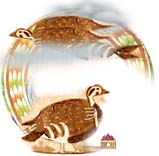 My
joy was great when I came across a book by one of the "enlightened"
of the older generation (if my memory is correct it was the Maphteah
by Shatkes), from which I learned that these geese were neither fat
nor thin and that the giant bird possessed neither feet nor wings, but
that the whole tale was merely a flight of the imagination, or, as the
ancients used to say, it was only a parable; the moral I have forgotten.
My
joy was great when I came across a book by one of the "enlightened"
of the older generation (if my memory is correct it was the Maphteah
by Shatkes), from which I learned that these geese were neither fat
nor thin and that the giant bird possessed neither feet nor wings, but
that the whole tale was merely a flight of the imagination, or, as the
ancients used to say, it was only a parable; the moral I have forgotten.
I was a child
then; but when I reached maturity, I realized that in truth, the
geese of Rabbah bar bar Hannah were real geese and the giant bird
was literally a bird. When regarded as natural creations of folk
imagination they lost their strangeness and incomprehensibility.
On the contrary, it would be all the more strange if we possessed
no such tales; in that case it would be extremely difficult to
explain so striking a difference between our people and all others,
one involving so great a triumph of reason over imagination that
the latter had become completely atrophied.
|
From:
On Jewish Law and Lore, by Louis Ginzberg (Jewish Publication
Society of America, 1955; reprinted by Atheneum (New York, 1970).
|