The Hebrew word for face
is panim, a word conjugated in the plural. It has been said that a
plural form is used because our countless expressions afford us many and varied
faces, each conveying a different mood, thought, reaction. Given the many
Hebrew expressions associating human emotion with facial color, we may assume
that our face is not only a mirror of emotion, but a kaleidoscope as well.
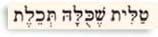
"A
tallit (prayer shawl) that is all blue" —
a mocking designation for a person who presents himself as a perfect
saint, without any taint or flaw.[1]
Talit
she'kulah tekhelet
"His
face became black like the soot on the cooking pot" —
a
description of how a man's face looks, when he is overcome with deep
sorrow or shame.[2]
(Hishhiru
panav k'shulei kedera)
From
the phrase,(hishkhir et panav) —
lit., made his face turn black; or embarrassed him —
we have the wonderful expression: "Things
that a person does in his childhood, make his face turn black [with
shame] in his old age."[3]
The
expression
(he'edim et panav) — literally, "he
reddened his fellow's face," means, of course, that he embarrassed
him. This association being so obvious, we move on to less likely hues.
Someone
who has embarrassed another person in public causes him to pale, hence
(hilbin
et panav) —he caused his face to turn white. So serious is the sin of embarrassing
a person in public, we learn from the Talmud, that, "Anyone who
causes another person's face to turn white in public, it is as if
he has spilled blood."[4]
To
show a friend one's white teeth, is a way to welcome him kindly and
warmly.
The Talmud teaches, "It is better to show your white teeth to
your friend, than to serve him milk."
[5]
Great potential material here, it seems, for a good television commercial
for milk, don't you think?!
And
finally, the English green of envy becomes the Hebrew green of anger in
the phrase:
(Horik panav ke-neged) — it made his face
green [with anger] against so and so.
For
more about a face that is painted over with color (zavu'a; read
"hypocritical") see the Hebrew article
in this COLOR edition.
[1]
JT Sanhedrin 27:4 [back] [2] JT Hagiga 77:4 [back] [3] BT Shabbat 152a [back] [4] BT Baba Mezia 58b [back] [5] BT Ketubbot 111b [back]













 (hishkhir et panav) —
lit., made his face turn black; or embarrassed him —
we have the wonderful expression: "Things
that a person does in his childhood, make his face turn black [with
shame] in his old age."
(hishkhir et panav) —
lit., made his face turn black; or embarrassed him —
we have the wonderful expression: "Things
that a person does in his childhood, make his face turn black [with
shame] in his old age."

 (he'edim et panav) — literally, "he
reddened his fellow's face," means, of course, that he embarrassed
him. This association being so obvious, we move on to less likely hues.
(he'edim et panav) — literally, "he
reddened his fellow's face," means, of course, that he embarrassed
him. This association being so obvious, we move on to less likely hues.
 (hilbin
et panav) —
he caused his face to turn white. So serious is the sin of embarrassing
a person in public, we learn from the Talmud, that, "Anyone who
causes another person's face to turn white in public, it is as if
he has spilled blood."
(hilbin
et panav) —
he caused his face to turn white. So serious is the sin of embarrassing
a person in public, we learn from the Talmud, that, "Anyone who
causes another person's face to turn white in public, it is as if
he has spilled blood."


 (Horik panav ke-neged) — it made his face
green [with anger] against so and so.
(Horik panav ke-neged) — it made his face
green [with anger] against so and so.

