Maimonides
equates the "righteous man" [hasid] of the gentile
nations" who has a share in the world to come with the gentile
who keeps these seven laws. Such a man is entitled to full material
support from the Jewish community.
To
the Gentiles who were not prepared to enter the fold of Judaism,
a moral code, known as the seven commandments of the sons of Noah,
was offered by rabbinic tradition. By righteous conduct based
upon these fundamental laws, taught the rabbis, the non-Jew could
earn divine approval. The seven laws are derived exegetically
from divine demands addressed to Adam (Genesis 2) and to Noah
(Genesis 9) —
the two individuals considered the progenitors of all mankind,
and are thus regarded as universal moral codes.
World-renowned
Bible scholar Moshe Greenberg discusses the evolution and ramifications
of the seven commandments of the sons of Noah, in classical Hebrew
thought.
After
the Flood, God laid down to Noah and his sons the terms of a new order.
Taking note of changed conditions, he now permitted them to eat animals
(who owed their very existence to humans) —
on condition that flesh with its lifeblood still in it not be eaten.
To take human life — cheap before the Flood
and depreciated by it — was declared a capital
offense, to be punished by a human agency; courts were thus authorized
to execute killers[1].
The descendants of Noah — all mankind (Gen.
10) — were thus held accountable to a minimal
number of divine commands.
Throughout
biblical literature, the Gentiles are required to answer for breaking
elementary moral laws, though nowhere is the ground for their responsibility
set out. The moral impulse of Gentiles, what we might call their conscience,
derives in the biblical conception from "god-fearing" (yir'at
‘elohim) — a common human virtue
that has no reference to knowledge of or revelations from the true God.
It keeps them from murder, adultery, and breach of faith; lack of it
accounts for Amalek's dastardly attack on Israel's stragglers.[2]
Evidently, this common property of all people is enough to make them
accountable for wrongdoing, despite their ignorance of God's laws.[3]
That
the Gentiles' worship of "false gods" was a sin came to be a common
doctrine only in Second Temple times. Deuteronomy even reflects the notion
that the misdirected worship of the pagans was a divine ordinance.[4]
The first hints of a new attitude occur in Jeremiah, with polemical fragments
against idolatry addressed to the pagans.[5]
From here it is but a step to making the renunciation of false gods one of
the minimal obligations of all people. This step was taken in the later formulation
of the "Noahite laws."
Second
Temple and rabbinic literature recognize universal standards of righteousness
apart from the peculiar obligations of Judaism. The notion of Noahite
laws binding upon all people becomes formalized, while the "fear
of God" is credited to a broad class of non-Jews who gave up belief
in the pagan gods, inspired by Jewish example. The Book of Jubilees,
dated variously between the third and first centuries BCE depicts Noah
teaching his sons "the ordinances and commandments and all the
judgments that he knew":
and
he exhorted his sons to observe righteousness,
and to cover the shame of their flesh,
and to bless their Creator,
and to honor father and mother,
and love their neighbor,
and guard their souls from fornication
and uncleanness and all iniquity
Whoso sheds man's blood, and whoso
eats the blood of any flesh,
shall be destroyed from the earth . . . (Genesis
7:20-39)
The
Talmud and Midrash canonized this notion in lists of commandments believed
to have been given to Adam and supplemented in a new revelation to Noah.
The generally accepted list consists of seven items, with respect to:
1) idolatry; 2) blasphemy; 3) homicide; 4) incest and adultery; 5) robbery;
6) eating the flesh of a live creature; 7) establishing a system of
justice. Although in theory these commandments were explicitly revealed
to Adam and Noah, what they prohibited was thought to be self-evident
to any human mind and conscience:
"You must keep my rulings" (Lev. 18:5): This refers to injunctions
of the Torah which, had they not been written in it, by right should
have been written, such as (prohibition of) robbery, incest, idolatry,
blasphemy, and homicide.[6]
During
Hellenistic-Roman times there were many Gentiles who, disillusioned
with paganism and attracted by the faith and mode of living of Jews,
renounced the gods and adopted rudiments of Jewish observance. While
in no sense regarded as Jews, such persons were esteemed as "those
who fear God" (yir'e shamayim); they were held beloved by
God and assured of their ultimate reward in the world to come.[7]
These
ideas were synthesized in the definition of the resident alien (ger
toshav) — the Gentile who may live in
Jewish territory. Of various theoretical definitions (theoretical because
they were formulated after loss of Jewish independence) the most widely
accepted was: the Gentile who observes the seven Noahite laws[8].
An eighth century midrash sums up the discussion:
The difference between the righteous Jew and the righteous Gentile is
this: a Jew is not considered righteous unless he observes the whole
Torah. But a Gentile is considered righteous if he keeps the seven commandments
laid upon the Noahites — the commandments
and their ramifications, and on condition that they understand their
obligation to stem, through their ancestor Noah, from the command of
God. If they keep them in this spirit, they have a share in the world
to come just like Jews — despite their non-observance
of Sabbaths and holidays, which they were never commanded to keep. If,
however, they kept the seven commandments because they believed them
instituted by some human authority, or as a dictate of reason; or if
they ascribed a partner to God, they receive a reward in this world.[9]
Thus,
not only are all humans as Adamites a single family, precious in God's
sight, but by observance of the universal moral laws laid upon the Noahites
they may be perfectly reconciled with God and enjoy the ultimate bliss.
The consequence of the classical Jewish doctrine of man was that for
man's salvation, neither Israel nor the Torah were, strictly speaking,
necessary.
Historically,
however, the Noahites had refused to accept their obligations; the nations
were ignorant of the true God and barbaric in their conduct.[10]
While the individual Noahite might be a God-fearer, for the salvation
of the race — a catalytic became necessary.
That role was assigned to Israel.
[1]
Gen. 9:1-7 [back] [2] Gen. 20:11, 39:8-9f, 42:18, Dent. 25:18 [back] [3] Ps. 147:20 [back] [4] Deut. 4:19 and 29:25 [back] [5] Jeremiah 10:11, 50:38; see Yehezkel Kaufmann,
The Religion of Israel (Chicago, 1963), 424f. [back] [6] Sifra, Ahare Mot[back] [7] Numbers Rabba, 8.2; (Tosefta Sanhedrin,
13,2); see Bernard Bamberger, Proselytism in the Talmudic Period
(Cincinnati, 1939)m 134ff; Saul Lieberman, Greek in Jewish Palestine
(New York, 1942), 77ff. [Back] [8] BT, Avoda Zara 64b, 65a [back] [9] Mishnat R. Eliezer, vi; Enelow, 121 [back] [10] BT, Avoda Zara 2bff [back]
From:
Studies in the Bible and Jewish Thought, by Moshe Greenberg
(Jewish Publication Society of America, 1995).
Prof.
Moshe Greenberg is one of the preeminent Bible scholars in the world
today, He holds the Prof. Yitzhak Becker Chair in Jewish Studies
at the Hebrew University of Jerusalem and has held visiting professorships
at the Jewish Theological Seminary, the University of California,
Yale University and elsewhere. He is the recipient of the prestigious
Israel Prize in Bible (1995) among other awards and honors. Prof.
Moshe Greenberg has published many scholarly works in the area of
bible commentary and scholarship.










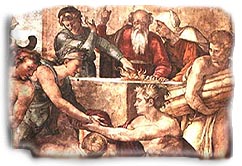 That
the Gentiles' worship of "false gods" was a sin came to be a common
doctrine only in Second Temple times. Deuteronomy even reflects the notion
that the misdirected worship of the pagans was a divine ordinance.
That
the Gentiles' worship of "false gods" was a sin came to be a common
doctrine only in Second Temple times. Deuteronomy even reflects the notion
that the misdirected worship of the pagans was a divine ordinance.


